
Research-Technology Management
What is RTM?
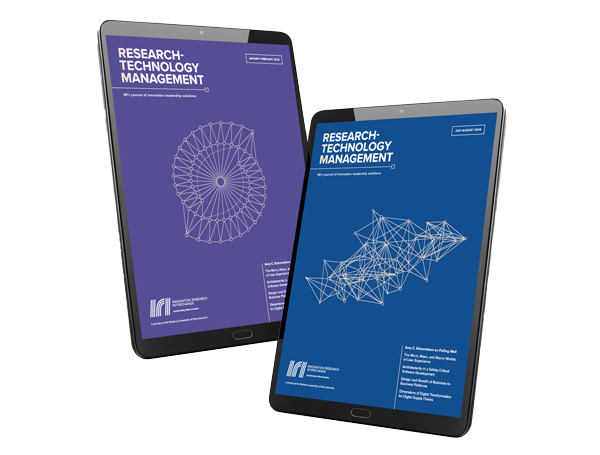
Research-Technology Management is a bi-monthly journal focused on translating academic research on innovation management into insights for practitioners. Published since 1958, it contains peer-reviewed articles covering the entire spectrum of technological innovation, from research and development through product development to marketing. RTM is a leading source of knowledge and best practices on innovation management for leaders of research, development, and engineering worldwide.
RTM Online is available to IRI members. Non-IRI members may subscribe or renew by visiting www.tandfonline.com/urtm. IRI members wishing to receive additional print copies may order by contacting societies@tandf.co.uk to subscribe.
IRI Members: Log In to Access RTM
RTM Online is an IRI member benefit. Sign in with your member email to open the current issue and the RTM archive.
Additional Links
August 26, 2026
As artificial intelligence evolves from a tool that supports human decisions to autonomous agents capable of planning and acting independently, traditional approaches to R&D governance are being challenged. Yat Ming Ooi examines how agentic AI disrupts established Stage-Gate and human-in-the-loop models, where oversight depends on people reviewing decisions at defined checkpoints. He proposes responsible innovation…
August 26, 2026
A Conversation with Robert G. Cooper Robert G. Cooper explores how artificial intelligence is reshaping new product development and what its rapid adoption means for the Stage-Gate process. In conversation with Jim Euchner, Cooper discusses AI’s potential to accelerate NPD, expand the design space, reduce costs and improve how companies develop and commercialize new products.
August 26, 2026
The COVID-19 pandemic forced organizations worldwide to show short-term organizational resilience by shifting rapidly to remote work to ensure business continuity and often survival. Various factors—including work content, process design, technology literacy, and culture—shaped how smoothly each organization navigated this transition. Over time, most organizations found a new equilibrium between remote and on-site work arrangements.
August 26, 2026
Design thinking remains one of the most widely adopted innovation methodologies, yet practitioners routinely encounter bottlenecks that limit its effectiveness at organizational scale. These bottlenecks include data overload in discovery, cognitive bias in problem definition, idea recycling in development, and slow iteration in delivery. Artificial intelligence (AI)—particularly large language models (LLMs) and agentic systems—offers a…
August 26, 2026
Sustainability has become a central principle for innovation and technology management, with firms investing heavily in clean technologies, resource efficiency, and innovation driven by environmental, social, and governance (ESG) principles. Unfortunately, sustainability—primarily focused on reducing harm—is insufficient to address escalating climate and societal challenges. Increasingly, scholars and practitioners advocate for a transition toward regenerative innovation…
August 26, 2026
Growing global medication use is creating an unintended environmental challenge as pharmaceutical residues increasingly enter wastewater and aquatic ecosystems. Renee Stern examines how prescription drugs, over-the-counter medications and antibiotics can persist through conventional wastewater treatment, affecting aquatic organisms and contributing to the spread of antimicrobial resistance. The article explores emerging solutions, including advanced oxidation, activated…
August 26, 2026
The concept of an “innovation ecosystem” suggests that bringing together the right resources, institutions and people can create an environment where innovation naturally flourishes. Randall S. Wright challenges that assumption, arguing that innovation is driven not by ecosystems but by people with the determination, expertise and originality to challenge the status quo. Drawing on the…
August 26, 2026
Robotics is moving beyond traditional factory automation as advances in artificial intelligence, sensing, mobility and human-machine collaboration expand what machines can do in the physical world. This article examines the rise of physical AI and what it means for innovation managers, from industrial and service robots to drones, autonomous systems and emerging humanoid technologies. Rather…
August 26, 2026
Joe Liu’s journey from rural China to global R&D leadership has reinforced a lesson that has shaped his approach to innovation: people and culture are at the heart of lasting business impact. Drawing on a career spanning academia, global R&D leadership at 3M and his current role as chief technology officer at James Hardie, Liu…

Mastering Digital Transformation: ‘4E Lessons’ from Leading Multigenerational Family Firms
June 18, 2026Relentless digital transformation is reshaping firm competitiveness, presenting both challenges and opportunities. This is especially true for multigenerational family firms, where complex intergenerational dynamics intensify the impact of transformation. This study builds upon a qualitative, empirical, and interdisciplinary research project that aimed to provide guidelines and best practices for digital transformation in family firms. Our…
