TVP – Process of R&D
- Resource Type
- Tool
- Authors
- Alan Fusfeld, Innovation Research Interchange
- Topics
- Innovation Metrics, Stage-Gate, Tools and Techniques
- Associated Event
- Publication
Background | User Guide | Program Contents | Stakeholders | List of Metrics
Stage Gate Model
Decision Gate A Decision Gate B Decision Gate C Decision Gate D
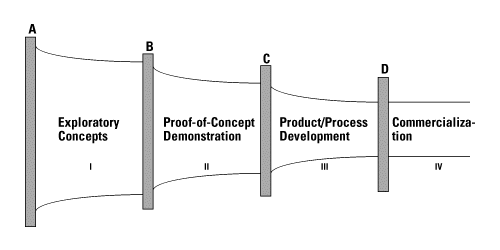
Process Stage I Process Stage II Process Stage III Process Stage IV
Overall Process Efficiency Metrics
- Use of project milestones
- Cycle time
- Delayed Stage kills
- Cost versus budget
- Efficiency of internal technical processes
- Use of cross functional teams
For overall process effectiveness see Value Creation metrics.
Definition of a Stage Gate Model
1.0 Definition of the Innovation Process
The term “innovation process” refers to the overall process in a company for conceiving and developing ideas and concepts into profitable products and processes for the company business(es). It is one of the 5 to 7 overall high- level business processes within the corporation,(e.g., Hammer*) . In order to maintain, diagnose, and improve the process, both effectiveness and efficiency metrics are required to support decision-making. The relevance of using a process model to support the choice of metrics is discussed in the next section.
Note that in the context discussed herein, the assumption is made that the innovation model will be technology-based. That is, innovation is founded in the efforts of the R&D organization, and that the overall function of the process is the embodiment of technology in the products of the business of the corporation. Progress through the full innovation process will involve the efforts of all corporate resources, including marketing, engineering, manufacturing, and service and support functions.
2.0 Relevance of Innovation Process Model to Metric Choice
Often stakeholders in the innovation process — R&D management, financial management, and corporate officers — need to utilize metrics which supply specific decision support information about corporate capabilities in innovation. These metrics are overall, or outcome metrics, which provide a grade or rating of the overall result of the innovation capability of the corporation or business in question. Such metrics might relate to value creation by the process, effectiveness of the overall process in terms of new product revenue or profit versus total R&D investment, or the ratio of new product revenue or profit to total company or business revenue or profit. Recommendations for stakeholder metrics can be found elsewhere in this metric advisor.
However, these metrics are often long-term and retrospective in nature, and while they serve to evaluate the overall process as a whole (and generally, but not always, on a lagging basis), they may offer little, if any, insight into the current or future state of the corporate innovation process or its many and diverse activities. To be useful for the on-going management and evolution of corporate innovation, a diverse set of metrics must be available which offer insight into current condition and future vision state of the process and many of its constituent parts. For many such metrics to be useful, they must be not simply outcome-oriented, but process-oriented, and specifically diagnostic of discrete subprocesses within the overall innovation process.
Each in-process metric must be related to a process model which ties it to the portion of the process of interest, from early idea or technology exploration through proof of concept to technology development to productization. The following process description is a relatively simple process model and defines the various sub-processes within that model in order to provide anchors for useful metrics within the innovation process.
3.0 Overall Description of the Stage Gate Model for the Innovation Process Used in this Metrics Guide
There are a number of possible representations of the corporate innovation process. One simple yet fairly effective representation is the so-called “stage gate model”.
The model in Stage Gate divides the overall innovation process into four stages, from concept exploration or “ideation” to the process of productization or commercialization. This division into four sections is arbitrary. An argument can be made for a three-stage model, or a more complex model of multiple sections and sub-sections. The four-stage model is chosen primarily for convenience, and to match a number of corporate models and those defined by scholars in the area of business processes. The shape of the model recognizes several realities of modern business.
For example, the process funnel narrows as the process proceeds from exploratory research or concept exploration through proof-of-concept to technology development and commercialization, illustrating pictorially the selective filtration that occurs in the process. There are typically many more ideas and concepts that are explored than are developed into significant technology capabilities in a business, and fewer still that emerge finally into finished products. In each stage of the process, the candidates dwindle, until only the most promising are brought to full production.
Similarly, the four gates, labeled A, B, C, and D, stand for the tests or decision-making activities that are exercised between the stages in the innovation process. Economic reality imposes a limit on the total level of technology and product development that each company can support. A second reality is that as each decision gate is passed, the resources and funding required to carry a given project to the next stage increases dramatically; a good rule of thumb is a 10X expenditure increase at each gate. These corporate “facts of life” impose a stringent set of conditions on the suitability of R&D programs which approach a gate. Each gate requires a set of metrics which ensure that only those programs most suitable to meet corporate business needs pass into the next subprocess.
The following sections describe the decision gates and stage processes shown in the stage gate model. Underlined terms link to appropriate metrics for the gate or process under discussion.
4.0 Description of the Major Subprocess Divisions in the Innovation Process Model
As noted in the introduction to the process model, the division of the innovation process model is arbitrary, but in general it seeks to approximate reality. The four divisions cover the very early technology or idea exploration phase of innovation (when possibilities are defined), a proof-of- concept phase when the mapping of ideas into the realities of the business world occurs, the development, and finally commercialization. Each of the separate phases, or subprocesses, is covered in the following sections, together with the entry gate which defines conditions for admission to that subprocess. Refer to the stage gate model in the discussions below.
4.1 Process Entry Gate (A) and Exploratory Concept Subprocess (I)
Gate A is the entry not only to Process I but to the entire innovation process. The purpose of Process I is to explore new ideas and concepts and set in motion as many promising “seed” projects as possible. The cost of research and investigation is small here. In companies where exploratory concepts consist of exploring product ideas and concepts, a single worker may have a project or even several in work simultaneously. Where true basic research is involved, it is most often at the University level, with industry participating through grants, contracts, or research agreements. In either case, there are typically many avenues being explored and no valid idea or concept is neglected.
The main consideration at Gate A is whether the idea or concept is strategically appropriate (at this stage, the alignment to corporate business goals may be ephemeral in some cases), and whether the expertise available to address the concept or idea is adequate. Metrics at Gate A should address these issues.
The purpose of Subprocess I is the validation of concepts or physical principles. Metrics for this process should simply address the validity of results and whether or not basic principles are established. Competency metrics may also be valuable to support assessments of required resources to execute projects.
4.2 Conceptualization Gate (B) and Proof-of-Concept Subprocess (II)
Gate B primarily tests whether a concept is validated or some physical principle has been established. Entry to Subprocess II depends mainly on appropriate resources being able to establish proof-of-principle in a business context, and whether the concept or idea to be tested has potential application areas within the business goals of the Metrics should test these concerns. The “filtration” function at this gate is fairly strong, since although the cost of research in Subprocess II is still not great, there will be many more candidate ideas than there will be resources to address them.
In Subprocess II, the emphasis is on proof-of-principle in real business applications. Business considerations such as market window and competitive reaction begin to be important, although there will still be concern about options and possible spin-offs of the technology or concept. Project metrics for tracking milestones and execution time become more important, although time frames are still lengthy and product requirements may be vague or broad-brush. Metrics concerning resources and technical capability are also appropriate.
4.3 Technology Development Gate (C) and Product/Process Development Subprocess (III)
The emphasis at Gate C is in suitability for product development. Gate C is also a strong filter; projects that pass this gate will be the few that are highly promising for commercialization and meet all the requirements for profitable business products. Candidate technologies which pass this gate will have forecast long-term corporate benefit, and the projects entering Subprocess III meet all the strategic requirements of fit, alignment, and attractiveness for the business. Metrics for Gate C must address these strategic requirements, as well as the tactical issues of assuring that the candidate projects have successfully completed the requirements of Subprocess II.
In Subprocess III, the emphasis shifts to harder-edge issues, such as timing and execution to assure that market windows are met and product needs are satisfied. There is also emphasis on maintaining and extending technologies to keep a competitive edge in the marketplace. Milestones are important due to cycle time issues, and project funding must be managed more carefully due to budgets which are typically millions of dollars rather than the 100X lower investment that may be typical on a project in Subprocess I. Metrics for Subprocess III must reflect the concerns of timely, accurate execution and tight budget control.
4.4 Product Launch Gate (D) and Commercialization Subprocess (IV)
Gate D is the last test prior to full product launch in most cases. Where concerns — and associated metrics — at the first three gates will have been primarily strategic (fit with corporate goals and competencies, strategic timing, alignment with business need), the test at Gate D is primarily whether execution in Subprocess III was timely and efficient. Concerns for entering full productization are about whether all major technical hurdles are cleared, and whether commercialization costs allow for profitable entry into the marketplace. Some strategic questions must still be addressed, including market need and timing, and metrics utilized here must address both the strategic and tactical issues.
Subprocess IV is obviously market-oriented, with careful management of commercialization and product costs, timing, and execution the key issues. Since budgets of hundreds of millions of dollars may be at stake, program and resource management are paramount, and metrics appropriate to the concerns will be chosen.
4.5 Gate Efficiency
A key concern at each gate is that decisions be as efficient as possible. That is, that projects passed through each gate be good candidates to benefit the business, providing the subsequent subprocesses are navigated successfully. Since the “filtration” function of the decision process at each gate will be partially imposed by the economic constraints of a business (only so much total funding is available for the projects in each stage), even some “fit” projects will simply “miss the cut” at each gate. However, those projects which pass the fitness criteria, whether actually entering the next stage or not, represent a measure of the efficiency of the previous gate decision process. A metric (discussed in the section on stage gate metrics) may be developed in terms of the percent of successful projects in the next stage for the previous gate.
* Hammer, Michael and Champy, James, Reengineering the Corporation: a Manifesto for Business Revolution, 1993, Harper Collins Publishers, Inc., 10 East 53rd Street, New York, NY 10022.
Questions or Comments?
If you have any questions or comments about the use of the Technology Value Program, we would like to hear them. Please send correspondence to green@iriweb.org. Modifications that will improve the usefulness of the Program will be incorporated into future updates.